Essay
The Price of Keeping Up
What we spend, what we carry, and what our children may never know about our years on the sidelines.
New0:00
Listen to this essay
AI-narrated audio · Written by SoccerHearth Dad
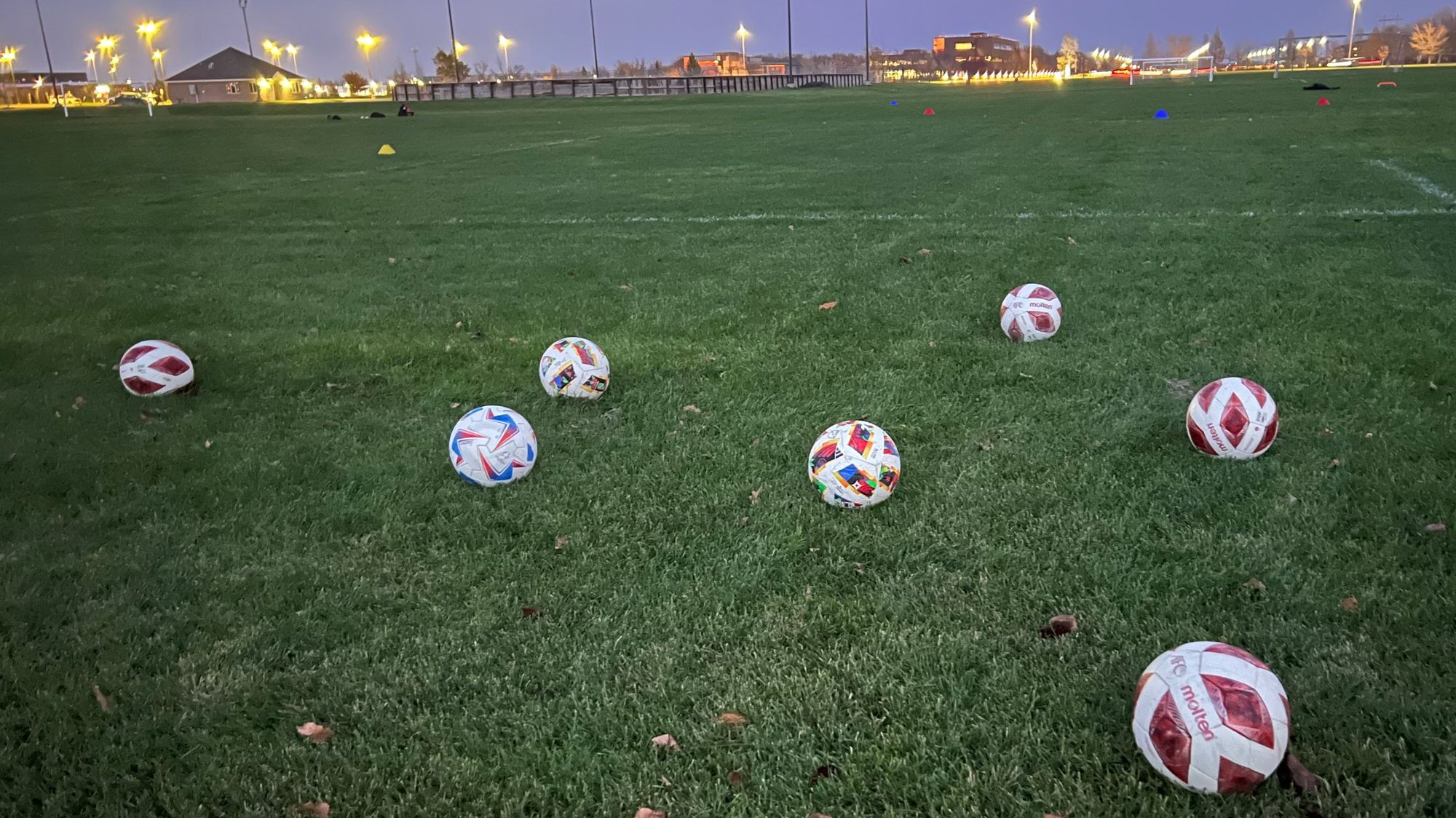
I recently began tracking what we spend on soccer for our two daughters.
Club fees, uniforms, tournaments, hotels, gasoline, winter training, private lessons. Some expenses arrive once a year; others so regularly I hardly notice them. Each seems reasonable when I pay it.
But when I added everything together, the annual total surprised me.
During supper with a colleague and his family, we mentioned how much we spend on soccer. They were surprised. What seemed extraordinary to them had gradually become ordinary in our household.
I wondered how many other parents would be surprised if they added everything up, too.
And why, even when we know what it costs, do we keep going?
When our daughters started playing, we wanted them to enjoy soccer, make friends, and stay active. We were signing them up for a game, not making an investment plan.
Then came tryouts, competitive teams, stronger leagues, and more opportunities. Fall soccer led into winter training. Winter prepared them for spring. Summer brought camps and another round of decisions. The soccer offseason is a fascinating concept. I have heard people talk about it, but I have rarely encountered one.
We never decided soccer would consume so much money, time, or thought. We made one decision at a time.
An extra session might help with a weakness. A stronger team might offer better competition. A tournament several hours away might give our child an experience she could not otherwise have. Each decision came with a reasonable explanation. Many probably were worthwhile.
But over time, the next opportunity begins to feel less optional.
The Cost of Saying No
We see what other families are doing. A teammate starts private training. Another family signs up for a camp. Someone moves to a stronger club. We can be genuinely happy for them and still wonder whether our own child is missing something.
Even when the money comes from our bank account, the people around us quietly change what feels normal.
Nobody tells us that we are falling behind.
But we begin wondering whether we are.
Sometimes we do not know that another program will help. We only know that we cannot be certain what will happen if we say no. What if this is the opportunity that makes a difference? What if our child could have gone further, but we did not provide the chance?
The cost of saying yes is visible. The imagined cost of saying no has no limit.
According to the Aspen Institute’s Project Play, American families spent an average of $1,016 on a child’s primary sport in 2024, up 46 percent since 2019. Soccer spending rose 69 percent [1]. These averages cover all levels, not only competitive clubs.
And even these numbers tell only part of the story. Families whose children compete in travel-intensive leagues such as the National Premier Leagues (NPL), Girls Academy (GA), or Elite Clubs National League (ECNL) may spend far more. Some carry these expenses for years, sometimes for more than one child. Our spending surprised me, but I know it is modest compared with what some families commit. I wonder how they manage the financial pressure, the time away from home, and the uncertainty of where it will all lead.
We may call this an investment. But an investment in what?
The National Collegiate Athletic Association (NCAA) estimates that roughly 7.9 percent of girls who play high school soccer go on to play NCAA soccer [2]. Other college pathways exist, and this figure predicts no individual child’s future. Most will not make a career of the game. Most parents know that.
Perhaps we are investing in possibility: confidence, friendships, a skill our children love, a place where they belong. We are also investing in the hope that someday we will not look back and wonder whether we should have done more.
There is a difference between fearing that our children will miss an opportunity and fearing that we will be the parents who failed to provide it. I suspect those two fears sometimes become difficult to separate.
The Long Way Home
Money is only one part of the price.
For families with two or three children playing competitive soccer, a weekend can become a puzzle before anyone kicks a ball. Different fields, different kickoff times, sometimes different cities. One parent goes one direction, the other goes another. Someone has to remember the uniforms, the snacks, the schedule, and which child is supposed to be where.
And then there are the long trips.
We travel hundreds of miles hoping our children’s teams will reach the championship game.
And sometimes they do.
A final beginning at four or five on Sunday afternoon in Kansas City is wonderful news for the children. For parents driving back to Fargo, it also means a very long night.
I have made those drives. Hours on the highway, sometimes through rain or snow, coffee keeping us going and legs growing stiff. After a weekend of tournament food, my belt has quietly moved a notch. By the time we reach Fargo, we have borrowed several hours of sleep from the future, with no clear plan for paying them back. And Monday morning arrives right on schedule.
We spend the weekend hoping the team will advance. Then, when it does, part of us starts calculating how many hours remain before work.
We want our children to go as far as possible.
Preferably before lunchtime on Sunday.
We are proud when they reach the final; we would not want them to lose just to get home sooner. Yet we celebrate the very things that make our lives harder.
A bank statement cannot show the full cost of being there. Nor can it show how differently families carry that cost. Some have relatives nearby to help, flexible work schedules, or room in the budget. Others make arrangements and sacrifices no one beside them on the sideline can see. A family with several children may spend an entire weekend dividing itself among games, then come together again only for the drive home.
Perhaps the loneliest part is feeling we cannot complain about what we chose. We registered, booked the hotels, and wanted these opportunities. So we keep our exhaustion or money worries to ourselves.
But loving the journey does not make every part of it easy.
When our children thrive at a club, we become loyal supporters, sometimes suspicious of rivals. Then a child needs a change, and the former rival suddenly looks welcoming.
Apparently, even our club loyalties come with a transfer window.
We adjust for our children. We may also choose our words carefully over team decisions, knowing that their sense of belonging matters more than winning an adult argument.
When the Sacrifices Begin Asking Questions
The more difficult adjustment, though, may be the one we make inside ourselves.
After an expensive weekend and a long drive, we may find ourselves counting the minutes our child spends on the bench. I have done it myself. At a tournament in Iowa, after a six-hour drive, I found myself timing how long one of our daughters played. It was less than five minutes.
We measure the trip in miles. Somehow, we start measuring the weekend in minutes.
We know development is uneven. We know a single game cannot define a player, and that the coach sees things we may not see.
Still, somewhere inside us, the sacrifices begin asking for an explanation.
We want to know that it has all meant something.
That feeling is difficult to admit because our child did not ask us to measure her game against the hotel bill. She did not choose how far we drove or how much we spent on training. We did.
A 2016 study involving 163 young athletes and their parents found that greater family financial investment was associated with children feeling more parental pressure, and that perceived pressure was associated with lower enjoyment and commitment. The study did not establish cause and effect [3]. But it leaves me with a question I cannot easily dismiss.
What do our children hear in our sacrifices, even when we say nothing?
A child may already be disappointed after a difficult game.
Does she also worry about disappointing the parent who spent the weekend getting her there?
Knowing When to Turn Around
In my university classes, I sometimes use Mount Everest as an analogy for preparation, uncertainty, and decision-making. I have read Jon Krakauer’s Into Thin Air and watched documentaries about the mountain. One question has stayed with me: why can it be so difficult to turn back after coming so far?
Climbers may spend years preparing and invest enormous amounts of money and hope. Some establish a turnaround time before setting out, knowing that the closer they get to the summit, the harder it may be to abandon the attempt. The distance already climbed cannot be the only reason to continue.
Youth soccer is not mountaineering. The stakes are different, and climbers make decisions for themselves while parents make many decisions on behalf of children. But I recognize something in the difficulty of reconsidering a path after years of commitment.
Another season can seem small compared with everything we have already done. Another camp feels like a natural continuation. I wonder whether, at times, our confidence in the destination grows simply because we have already traveled so far.
The earlier years were not wasted. They were years of playing, learning, traveling, and growing. The question is whether the next decision still serves the child who stands in front of us now, rather than the future we once imagined.
We can pay for coaching and encourage our children, but cannot make the pass or win the tackle. The right choice looks obvious from our folding chair, where nobody is pressing us for the ball.
We can see the game. We cannot play it for them.
Nor can we decide how long they will love it, how quickly they will improve, or what they will eventually want from it. The Aspen Institute’s 2026 youth survey found that fun and playing with friends were among the leading reasons children said they liked sports. These are ordinary pleasures, but they are not small ones [4].
What We Hope They Remember
Our daughters are learning to play soccer. We are discovering how to stand beside them without deciding where they must go. Perhaps the long drives teach us something, too: how to listen, how to wait, and how to share a part of childhood that will not last forever.
I hope our daughters will eventually understand what went into those years: the work schedules rearranged, the expenses considered, the drives made when we were tired. Not because they owe us goals, victories, or a return on our investment. Those were choices we made.
Gratitude is not the same as debt. I would be happy with a simple thank-you someday. An offer to carry their own soccer bags would also be welcome.
I still track the expenses. I suspect another reasonable-looking opportunity is already on its way. I do not regret giving our daughters the chance to play. The game has given them more than I could ever put in a spreadsheet.
But I am learning to separate what I hope for our children from what they hope for themselves.
Years from now, they may remember a teammate who encouraged them, a goal they scored, a difficult loss, or the feeling of belonging to a team. They may remember reaching a championship game in Kansas City.
I may remember the highway back to Fargo, the coffee, the weather, and the alarm waiting on Monday morning.
Both are part of the same story.
I hope they remember how much they loved playing.
And someday, perhaps, they will understand how much we loved being there.
Sources
[1] Aspen Institute Project Play — Family Spending on Youth Sports (2025)
[2] National Collegiate Athletic Association (NCAA) — Estimated Probability of Competing in College Athletics (2026)
[3] Dunn et al. — Family Relations (2016)
[4] Aspen Institute Project Play — National Survey of Youth and Sports (2026)
Stay connected with Soccer Hearth
New essays and perspectives on youth soccer, delivered to your inbox.
Free. Unsubscribe anytime.