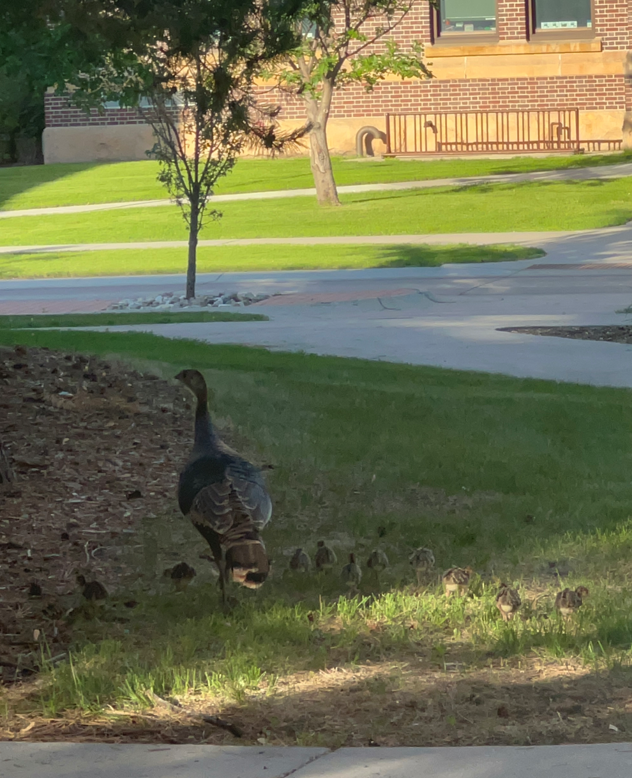
A few evenings ago, while walking near our department building, I noticed a wild turkey hen leading ten young poults through the grass.
At first, I simply stopped to admire them.
The poults followed closely behind their mother as she moved across the lawn. Some stayed directly at her feet. Others wandered slightly to the side before quickly returning to the group.
I took out my phone and began recording.
As I moved closer to get a better photo, the hen immediately reacted.
She placed herself between me and her poults.
She didn't attack. She didn't panic. She simply positioned herself where she believed she needed to be, standing between her young and a possible threat.
I stood there for several minutes watching.
And a question entered my mind. Not about birds. About soccer.
Is there such caring in coaching?
More Than Tactics
When people discuss coaching, the conversation often centers on tactics, formations, technical development, training methods, playing time, and results.
Those things matter.
But standing there watching that mother bird, I was reminded that leadership begins with something much more fundamental.
Care.
The mother bird was not protecting one poult. She was protecting all ten.
Not the strongest. Not the fastest. Not the poult most likely to survive.
All of them.
Her attention extended to the entire group.
That observation made me think about youth soccer. Every team contains players at different stages of development.
Some players are naturally confident. Some are hesitant. Some mature early. Others develop later. Some need very little encouragement. Others need reassurance every day. Some players naturally attract attention. Others quietly blend into the background.
Yet every player arrives carrying dreams, insecurities, strengths, weaknesses, hopes, and fears that are often invisible to everyone around them.
Looking at those ten poults, I found myself thinking about a simple question.
Every poult in that photograph mattered to the mother bird.
Does every player matter that way to us?
What Does Caring Actually Look Like?
This is where the question becomes more difficult.
Because caring is not the same thing as being nice.
The mother bird did not ask the poults where they wanted to go. She led. The poults followed. She made decisions. The poults trusted. Her responsibility was not to make every poult comfortable. Her responsibility was to help them survive and develop.
The same may be true of coaching.
A coach who genuinely cares about players may sometimes challenge them. Hold them accountable. Ask more of them than they believe they can give. Move them to a different position. Encourage them to confront weaknesses instead of avoiding them.
From the player's perspective, those moments may not always feel comfortable. Yet discomfort and neglect are not the same thing.
In fact, some of the most caring coaches are the ones who refuse to let players settle for less than they are capable of becoming.
Perhaps the real question is not: "Does my coach make me comfortable?"
Perhaps the better question is: "Does my coach care enough to help me grow?"
The Importance of Being Seen
As I continued watching, another thought occurred to me.
The mother bird was responsible for ten poults. Ten. Yet when I approached, she reacted as though every single one mattered.
That may sound obvious. But in youth sports, many players spend years wondering whether anyone truly notices them. Not whether they start. Not whether they score. Not whether they receive praise.
Whether they are seen.
Every player wants to know that someone notices their effort. Their improvement. Their struggles. Their potential.
In science, we often say that measurement changes what we pay attention to. We study what we notice. We improve what we monitor.
Perhaps coaching is not entirely different. Players often grow where attention is directed. The challenge, of course, is that every player needs some of it.
Maybe caring begins with something simpler than we often realize.
Maybe caring begins with noticing.
The Poults Trusted
Another detail stayed with me long after I walked away.
The poults followed their mother almost instinctively. They did not know where they were going. They only knew who they were following.
That image stayed with me because trust is rarely discussed as much as talent, rankings, playing time, or results. Yet trust may be one of the most important ingredients in development.
A player may be focused on this weekend's game. A parent may be focused on this season. A coach may be thinking about where that player could be two years from now.
Those perspectives do not always align. Development often requires trusting a process before fully understanding it.
Trust does not mean blind obedience. Trust must be earned. But when players trust coaches, parents trust coaches, and coaches trust players, development becomes much easier.
The poults did not know where they were going. They only knew who they were following.
The Purpose of the Nest
As the little family moved farther away, another thought occurred to me.
The mother bird was doing everything she could to protect her poults. But she would not protect them forever. At some point, they will have to navigate the world on their own.
The purpose of her care is not dependence. The purpose of her care is independence.
That may be one of the hardest lessons in both parenting and coaching. We naturally want to protect young people from disappointment, failure, criticism, and hardship. Yet resilience rarely develops without challenge. Confidence is not built by avoiding difficulties. It is built by overcoming them.
The purpose of a nest is not the nest. The purpose of a nest is the sky.
The best coaches understand this. Their goal is not to create players who need them forever. Their goal is to develop players who can think independently, solve problems, lead teammates, and eventually guide others.
Lessons Hidden in Plain Sight
As a microbiome researcher, much of my work focuses on developmental programming. We study how maternal nutrition, maternal health, and maternal microbial communities influence offspring long before the offspring understand what is happening.
Standing there watching that mother bird, I realized nature has been teaching similar lessons for millions of years.
Growing up on a farm, I spent countless hours around animals. At the time, I wasn't learning leadership, coaching, or developmental theory. I was simply living life.
Looking back, I realize many of the lessons I now apply in research, parenting, and soccer were visible long before I understood them. They were present in the way animals cared for their young, protected them, challenged them, and gradually prepared them for independence.
Development rarely happens by accident. Someone — or something — is usually guiding it.
Nature has been teaching these lessons for millions of years. We simply have to notice.
Final Thoughts
Eventually, I stopped recording and simply watched.
The mother bird continued leading. The poults continued following. Each one trusting. Each one learning. Each one gradually becoming something they were not yet.
As I walked away, I found myself thinking once more about that original question.
Is there such caring in coaching?
I think the best coaches would answer yes. Not because they protect players from every challenge. Not because they make every player comfortable. But because they care enough to notice, guide, teach, challenge, encourage, and prepare young people for a future beyond the game itself.
Every poult in that photograph mattered to the mother bird.
As I walked away that evening, I couldn't help wondering:
Does every player matter that way to us?
Like the mother bird, the best coaches understand that development is not about keeping young people safely in the nest forever.
A bird is safe in its nest. But safety is not the purpose of its wings.