Last fall, one of my daughters ran a one-mile cross-country race. She was in front for almost the entire mile. Near the end, she slowed slightly. She did not realize the finish line was as close as it was.
Another girl passed her in the final seconds.
People were cheering as she crossed the line in second place. She burst into tears.
On the drive home, she was still thinking about the race. She asked me what she could do to get better. Could she run to school? Was there a coach who could help her? She wanted to know what she needed to do so that the next time she raced that girl, she could beat her.
So she trained.
She ran to school. She practiced. And when they met again, she won.
There was something simple about it. She had lost a race. She knew where she had lost it. She worked on what she could change. Then she got another mile and another finish line.
For a long time, I thought soccer worked the same way.
I am a scientist, and I carried the logic of an equation from the laboratory to the soccer field. One of the simplest reactions is familiar even outside chemistry:
The inputs are known. Under the right conditions, so is the product.
I had built a similar equation for youth soccer. If a child practiced consistently, learned the fundamentals, listened to her coaches, worked on her weaknesses and kept showing up, she would improve. If she improved enough, I believed opportunity would follow: the stronger team, more minutes, a starting position, and one day the level she dreamed of reaching.
The first part of that equation still makes sense to me. I have watched practice change a player. Her first touch becomes softer and passes begin arriving sooner. Over time, she starts looking over her shoulder before the ball reaches her and using the weaker foot she once avoided.
But I saw the second part of the equation begin to fail one winter.
When the fall season ended, many girls turned to other things. Some played hockey. Some took the winter away from soccer. Only a few continued.
Among those who kept going were girls who had spent much of the fall coming off the bench.
They trained through the winter. They practiced with older players and played winter tournaments. There were also individual sessions and nights outside in the cold, long after the regular outdoor season had ended. They were doing what young players are so often told to do when they want more opportunity: keep working.
Months passed. Spring came.
The girls who had trained through the winter were better players than the girls who had entered the winter. I could see it.
But their place in front of the coach had barely moved.
The starters were still largely the starters. The substitutes were still largely the substitutes.
That stayed with me.
Winter training did not entitle anyone to a starting position. Another player did not become less deserving because she spent her winter playing hockey. A coach may see qualities in one player that a parent cannot see from the sideline. A team may need different things from different players.
Still, I had expected improvement to change opportunity. I had expected the equation to move.
Then seasons changed in other ways. A coach could move from one club to another with players following, suddenly crowding a roster and bringing relationships built elsewhere onto the same field.
And favoritism exists too.
Not every disappointing decision is favoritism, and I do not want my children to learn to explain every setback that way. Sometimes another player is simply better. Sometimes a coach sees a weakness a parent does not. But there are also moments when familiarity matters more than it should, when an exception seems available to one child but not another, or when a judgment formed months earlier appears difficult for a player to change.
None of those things can be corrected by taking another hundred touches against a wall.
That was where soccer began to look very different from the mile race.
When my daughter was passed near the finish line, there was almost nothing to interpret. The other girl crossed first. My daughter crossed second. The clock recorded both of them.
She cried, but she knew what had happened.
In the car, she did not ask me whether the other runner knew the coach. She did not ask whether the rules had changed. She asked how she could become faster.
Then she went to work.
Soccer can ask the same effort from a child without always giving her such a clean answer.
A player can spend a winter doing what she was asked to do and return in spring as a better player, yet still be seen through the place she occupied before the winter began. Then a coach changes, a roster changes, or new players arrive, and the conditions shift again.
The child has changed too. That part can easily get lost.
A roster placement can tell a child where someone has placed her today. It cannot undo the player she became while getting there. The winter hours do not disappear because she remains a substitute. Her first touch does not become worse because someone else starts. The nights in the cold still happened.
The harder lesson has been learning what I can honestly promise my children.
I can tell them that practice will change them. Repetition matters. Fitness can be built. A weakness can become a strength. When a coach identifies something that needs work, there is value in going home and working on it.
I cannot promise what another person will do with that improvement.
I cannot promise a certain roster, a starting position or a certain number of minutes. I cannot promise that the club will look the same next year, that a coach will stay, or that the standards applied today will be applied exactly the same way tomorrow.
That does not make the work meaningless. It changes what I understand the work to be.
I think back to that one-mile race.
My daughter had been leading almost the entire way. Then another runner went past her. There were tears at the finish and questions in the car. Later there were mornings when she ran to school because she wanted to be faster the next time.
Eventually, the next time came.
This time she knew where the finish line was. She kept running through it.
Soccer has not always given my children such a visible line.
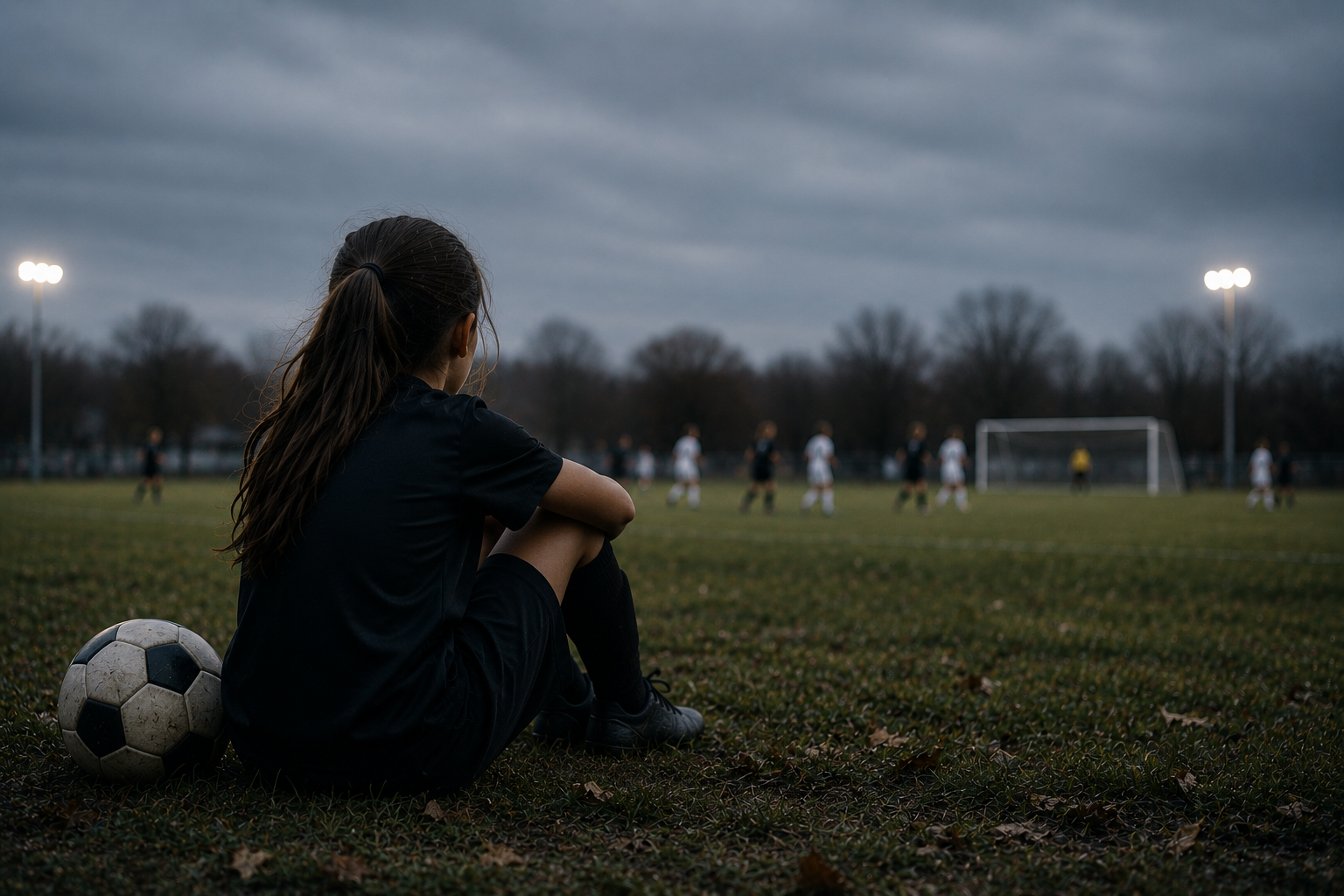
But after practices and roster decisions, after good days and difficult ones, there is still a ball.
Some evenings, one of my daughters takes it outside. There is no roster there. No team color. No list of names arriving from another club. No one deciding who starts.
She puts the ball down on the grass and begins again.
One touch, then another.
The ball comes back.
And she keeps going.